

Public Consultation
Navan Railway Public Consultation on the Emerging Preferred Route
The non-statutory public consultation for the Emerging Preferred Route is now closed. Thank you to everyone who made a submission.
What is Navan Railway?
Navan Railway is a proposed extension of Iarnród Éireann’s network. This new railway will deliver frequent, reliable and sustainable public transport between Navan and Dublin City Centre, via M3 Parkway.
This project is identified as a key measure in the National Transport Authority’s (NTA) Greater Dublin Area Transport Strategy 2022 - 2042. The development of Navan Railway is subject to funding and planning permission.
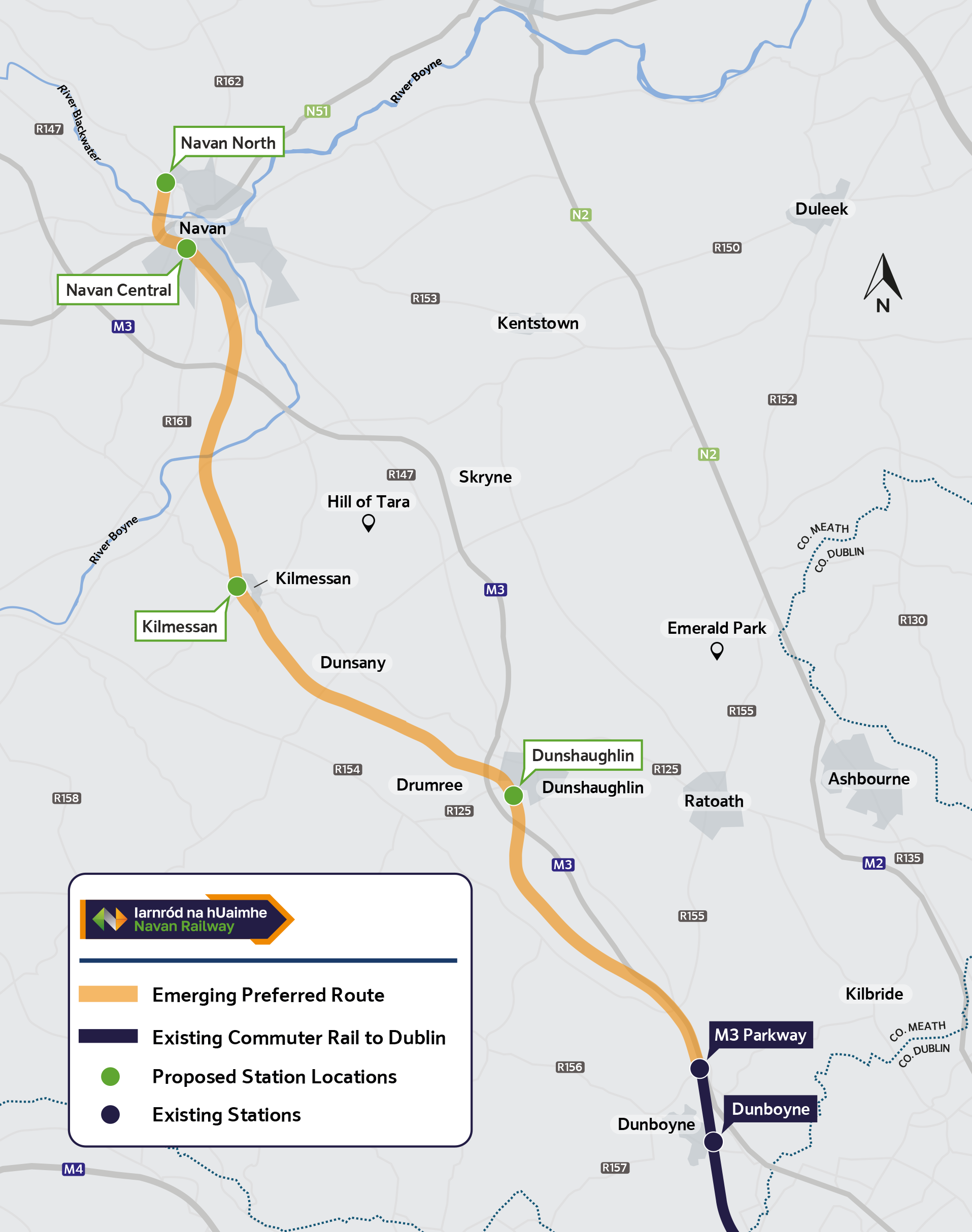
The Emerging Preferred route for Navan Railway
Project Benefits
Navan Railway will bring many benefits, including:
- Extension of DART+ to Navan – Navan Railway will be an extension of DART+ from M3 Parkway that will bring high frequency and high-capacity electrified rail services to Navan
- Enhanced Connectivity – This project will deliver integrated public transport and connect communities along the route with Ireland’s expanding rail, tram and wider public transport network. Navan is the largest town in Ireland not currently on Iarnród Éireann’s network
- Enabling Growth & Development – Navan Railway will enable the delivery of housing, as well as economic development for communities along the proposed route
- Electrified Rail Travel – The electrified Navan Railway will encourage sustainable transport choices, supporting the transition to a low-carbon, climate resilient society and reducing dependency on private cars
- Expanded Access to Services – The Navan Railway will expand local communities’ access to employment, education, healthcare and other services across the proposed route. This project will also facilitate travelling by public transport to County Meath for commuting, leisure and tourism
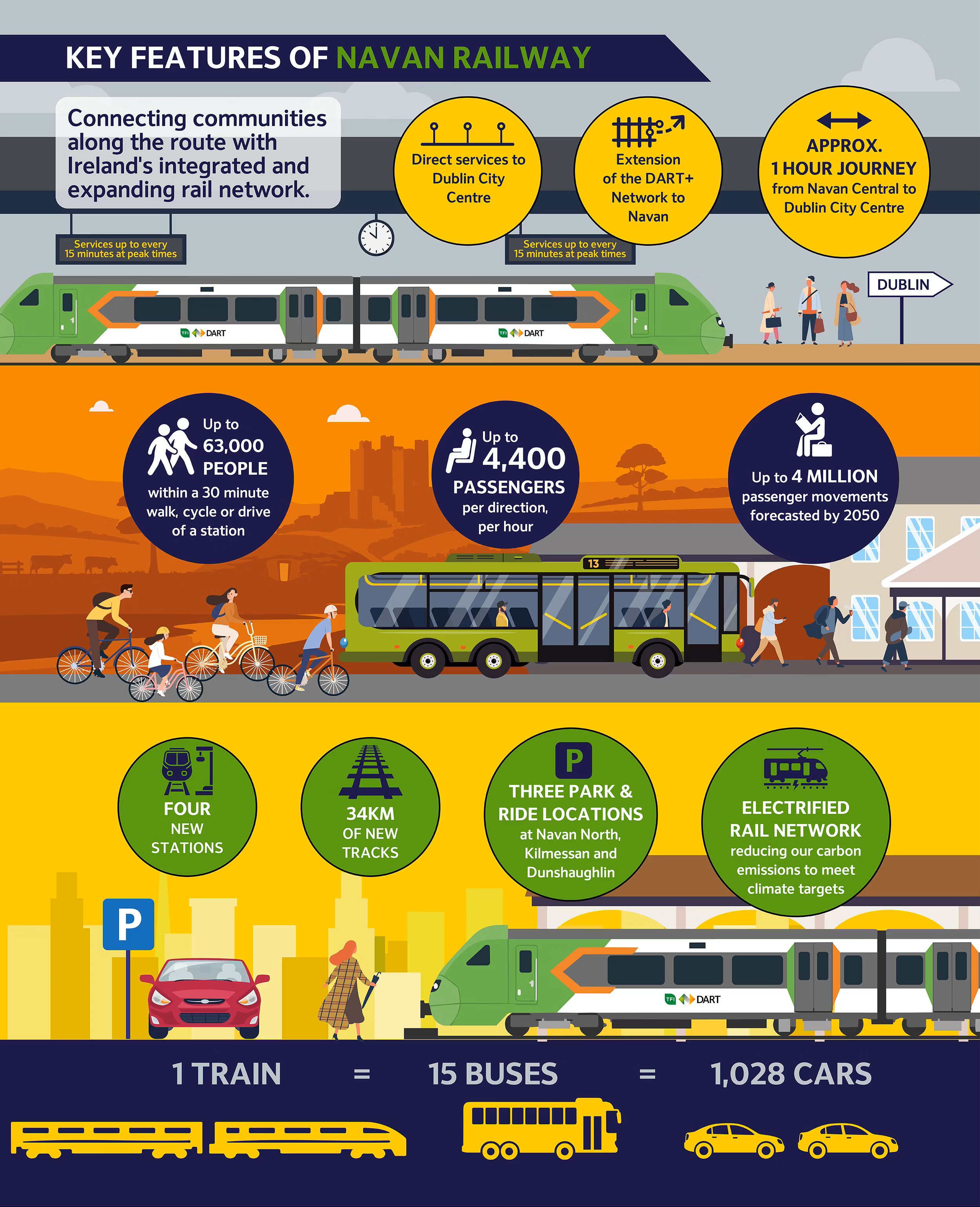
Key Features of Navan Railway
The Emerging Preferred Route and New Train Stations
The Emerging Preferred Route is a wide corridor within which the proposed railway, stations, parking and other associated infrastructure will be located.
A robust and step-by-step option selection process has been undertaken to identify the Emerging Preferred Route. As part of this process, a 34km route connecting Navan and the M3 Parkway has been identified, as well as four new station locations at Navan North, Navan Central, Kilmessan and Dunshaughlin.
Your feedback as part of this public consultation will help to refine this corridor and identify the Preferred Route that will be progressed to planning (Railway Order application).
Useful Downloads and Links
How To Engage
The project team is available to answer any queries you may have on Navan Railway. To get in touch, or make a submission to the consultation, you can:
- Email us at navan@irishrail.ie
- Phone us on (01) 7034451
- Write to Navan Railway Project, Iarnród Éireann, Haymarket House, Smithfield, Dublin 7, D07 CF98
- Come along to one of our consultation events
Next Steps
Navan Railway is at an early stage of development. Over the coming months, all feedback submitted to the public consultation will be considered and further design work and environmental studies will be undertaken. The next step will be to identify the Preferred Route.
A Railway Order application (similar to a planning application) to An Coimisiún Pleanála will then be prepared and lodged.
Iarnród Éireann will endeavour to keep all stakeholders updated and informed as the project progresses through the phases of development.
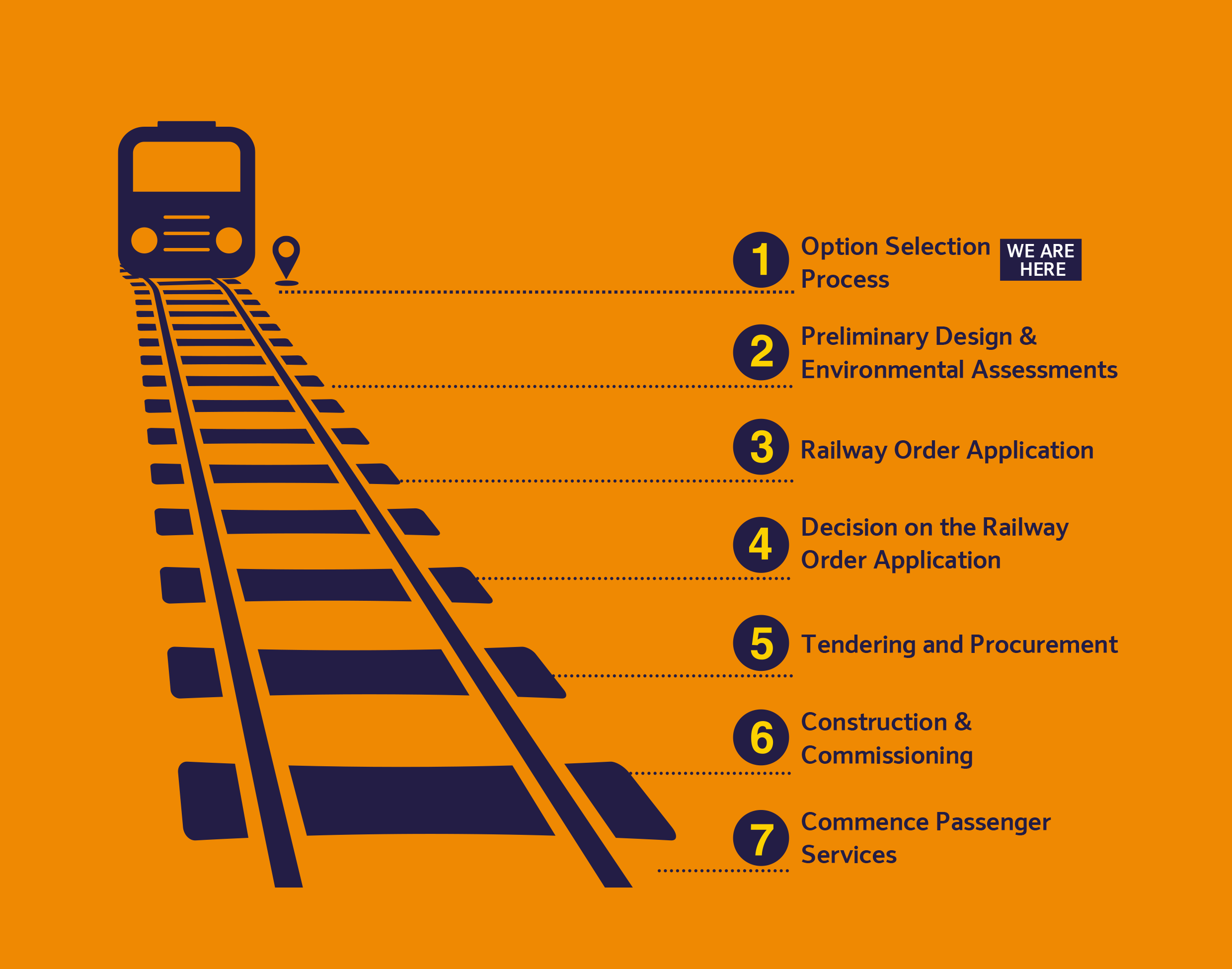
Steps to deliver the Navan Railway project
Frequently Asked Questions
Project Overview
Navan Railway is a proposed extension of the Iarnród Éireann rail network between Navan and Dublin City Centre via M3 Parkway.
The project is being developed to improve public transport connectivity, support future population and economic growth, and reduce dependency on private cars. It also supports wider national, regional and local policy goals including decarbonisation, regional connectivity and compact growth.
The project is being developed and delivered by Iarnród Éireann. The National Transport Authority is the approving authority for the project at this stage.
The Emerging Preferred Route is the wide corridor within which the proposed railway, stations, car parks and associated infrastructure would be located. It is not the final design. This is the route that is being presented for consultation and further refinement.
The identified corridor is approximately 34 kilometres in length and connects Navan and M3 Parkway.
Yes. The current consultation is taking place before the route is finalised. Feedback from the public, further design work, environmental studies and technical assessments will all help inform the Preferred Route.
Many possible options for Navan Railway have been considered. These options were assessed through a robust and step-by-step process. This process started with a longlist of potential public transport options. The options that scored the highest formed a shortlist that were analysed in greater detail and considered:
- Engineering design
- Detailed costings
- Passenger demand forecasting
- Environmental and economic appraisal
- Other tools such as Cost-Benefit Analysis (CBA), Cost-Effectiveness Analysis (CEA), and Transport and Accessibility Appraisal (TAA) to assess value-for-money and benefits
The Emerging Preferred Route, including station locations, is the shortlisted option that has been selected following this process.
The proposed route will reuse much of the disused railway that was closed in the 1960s. However, it moves away from the historical route in places to avoid impacting developments that have been constructed since the railway was closed and to bring a station close to Dunshaughlin town. The Emerging Preferred Route for Navan Railway also responds to present-day planning, engineering and environmental constraints.
The Navan Railway project will bring many benefits, including:
- Extension of DART+ to Navan with frequent and high-capacity train services
- Connecting communities along the route to Ireland’s expanding and integrated public transport network. Navan is the largest town in Ireland not currently on the rail network.
- Facilitating future social and economic growth in the project area
- Encouraging sustainable transport choices and reduced dependency on private cars
- Enhancing access to services for communities along the route and encouraging travel to County Meath by train
The overarching objective of the Navan Railway project is to provide a public transport option that is frequent, reliable, integrated, sustainable and attractive. The project also aims to deliver a public transport option that offers safe, high-capacity connectivity between Navan, the Greater Dublin Metropolitan Area and intermediate urban areas.
The project’s sub-objectives include:
- Supporting compact growth,
- Reducing car dependency and congestion,
- Improving access to employment, education and services,
- Contributing to decarbonisation targets,
- Minimising environmental impacts and
- Improving overall transport safety.
The original Navan to Clonsilla railway closed in the 1960s. The section of the original railway from Clonsilla to M3 Parkway was reopened in 2010. Works began to reopen the Navan to M3 Parkway section, but they were put on hold in 2011 due to the economic challenges that Ireland faced at that time.
The current Navan Railway project has started from the beginning to comply with current Irish and EU legislation, policy requirements and updated planning assumptions.
Navan Railway is at an early stage of development. Before any construction could commence, the project must complete the route selection process, secure planning approval and funding, and undergo necessary design, environmental and procurement processes.
Route, Stations and Access
Four new stations are proposed as part of the Emerging Preferred Route: Navan North, Navan Central, Kilmessan and Dunshaughlin.
The current proposals identify the following possible locations:
- Navan North: Off Ratholdren Road along the disused Kingscourt railway line
- Navan Central: Between Carriage Road and Trim Road (R161)
- Kilmessan: On a greenfield site west of the village accessed from the L2205
- Dunshaughlin: On a greenfield site to the west of the town accessed from main street and the M3 Junction 6 Service Station roundabout.
No. The locations presented now are part of the Emerging Preferred Route. The exact position, layout and detailed design of each station will continue to be refined as the project develops.
Yes. Navan Railway will be an extension of the planned DART+ West line from M3 Parkway.
An Electrified Railway means that the trains on that line are powered by electricity rather than diesel or another fossil fuel. Electrified Railways typically require Overhead Line Equipment (OHLE) and electrical substations to be installed (similar to the current DART network in Dublin).
Further detail on electrification infrastructure required for Navan Railway, including locations of any proposed substations, is expected at later stages of design.
The design of the four new stations for Navan Railway is at an early stage. We have identified potential locations for each station, as well as parking and access road requirements. Each proposed station is expected to include two platforms. The stations will be designed to meet modern standards and to be integrated with other means of travel including buses, walking and cycling.
Accessibility has been a key consideration. The stations are expected to be designed to meet modern accessibility standards and relevant best practice.
Yes. Large Park-and-Ride facilities are proposed at Navan North, Kilmessan and Dunshaughlin. Parking at Navan Central is expected to be more limited because of its urban location.
Yes. The stations are intended to integrate with other modes of transport, particularly bus services, pedestrian routes and cyclist infrastructure.
Property and Land Impacts
Yes. When the Navan Railway was closed in the 1960s, the infrastructure was dismantled and the lands were sold. When Navan Railway receives planning approval (Railway Order) and the project progresses to construction, some lands and property will need to be purchased.
At this stage we have identified a wide corridor within which the proposed railway, stations, car parks and other infrastructure may be located. This corridor is wider than what the final railway will be. The exact land take has not yet been confirmed.
If you received a letter from the project team stating that your property may be affected by the Emerging Preferred Route, this means that your property falls within the wide corridor where the proposed railway, stations or other infrastructure (temporary or permanent) may potentially be located.
You can contact our project team on (01) 7034451 or at navan@irishrail.ie to discuss the potential impacts at your property.
Iarnród Éireann may need access to private land for activities such as surveys or investigations. Where access is required, we will contact the landowner or occupier in advance to seek permission.
Any lands that are required to be accessed in the construction or operational phases of Navan Railway will be identified in the Railway Order application for An Coimisiún Pleanála’s approval.
As with any infrastructure project, there may be some local impacts during construction and operation. At this stage however, the type and scale of works required at each location has not been finalised. More detail will become available as the route is refined and the environmental assessments progress.
If you received a letter from the project team, your property is within the current wider corridor and may potentially be affected. If you did not receive a letter but remain concerned, you can contact our project team on (01) 7034451 or at navan@irishrail.ie to discuss the potential impacts at your property.
Consultation and Engagement
Your feedback and insights on the Emerging Preferred Route, station locations and other features are important to confirming the Preferred Route for the project.
Your comments are welcomed on any:- Views you may have on the Emerging Preferred Route and station locations
- Environmental considerations during construction, operation or maintenance of the project
- Local knowledge that you believe the Design Team should be aware of
Submissions can be made online through the project feedback form. You can also contact the project team by email, phone or post.
This project webpage will be updated as Navan Railway project advances.
You can also request to be added to our email list to receive updates by:
- Completing our online consultation response form
- Contacting the project team by phone or email
Iarnród Éireann will endeavour to keep all stakeholders updated and informed as the project advances through the phases of development.
Yes. The project team will be available to discuss the project at our public information events:
- Navan Solstice Arts Centre (C15 KWP1) - Wednesday 27 May, 2pm – 8pm
- Dunshaughlin Pastoral Centre (A85 W886) - Thursday 4 June, 2pm – 8pm
- Navan Education Centre (C15 RK03) - Tuesday 9 June, 2pm – 8pm
- Station House Hotel, Kilmessan (C15 N40D) - Tuesday 16 June, 2pm – 8pm
- Online Public Webinar - Thursday 18 June, 7:30pm - 8:30pm
All submissions received during the consultation period will be reviewed by the project team. The feedback will help refine the route, inform design development and support environmental assessment work as the project moves towards identification of the Preferred Route.
A report will be published summarising the feedback received and detailing how it informed the design development.
Yes, there will be further consultation and stakeholder engagement as the project progresses.
Any information provided during the public consultation will be retained during the design and construction phase of the project. By providing details during the public consultation phase, you are consenting to the use of personal data in accordance with Iarnród Éireann’s Privacy Statement which is available at www.irishrail.ie/legal/terms-of-use-privacy-statement-cookie-policy to allow Iarnród Éireann to better understand your needs in relation to this project.
If, for any reason, you wish to provide information or interact with the project on a confidential manner and not have such information disclosed because of its sensitive nature, then it shall be the responsibility of the person or body when supplying the information to make clear this wish and to specify the reasons for the information sensitivity.
Planning, Environment and Next Steps
Yes, Navan Railway will require planning permission to proceed to construction. A Railway Order application (similar to a planning application) will be submitted to An Coimisiún Pleanála to make a decision on the project.
A Railway Order is the statutory planning process for railway infrastructure projects of this nature and is broadly similar to the planning process for strategic infrastructure. The Railway Order application process is set out in the Transport (Railway Infrastructure) Act 2001 as amended by the Strategic Infrastructure Act 2006.
Yes. The project is strongly supported by national, regional and local policy objectives, including public transport decarbonisation, regional connectivity, compact growth and the Greater Dublin Area transport strategy.
The Railway Order application is expected to include technical documents, drawings and an Environmental Impact Assessment Report. Together, these would describe the project, identify likely impacts and set out proposed mitigation where required.
As with any major infrastructure project, Navan Railway will bring both temporary and permanent impacts to the environment and local communities. The project’s design will make every effort to ensure that negative impacts are avoided, reduced or mitigated as far as practicable and that positive effects are maximised.
An Environmental Impact Assessment Report (EIAR) will be submitted as part of the Railway Order application for Navan Railway. The EIAR will consider the likely effects on the local environment and where necessary, identify measures to mitigate any potential adverse effects.
Navan Railway is subject to funding, and the project will need to achieve necessary approvals and funding as it progresses through the stages of development.

